Is a VPN Legal in Turkey? Blocks, the Court Case and the Draft Law
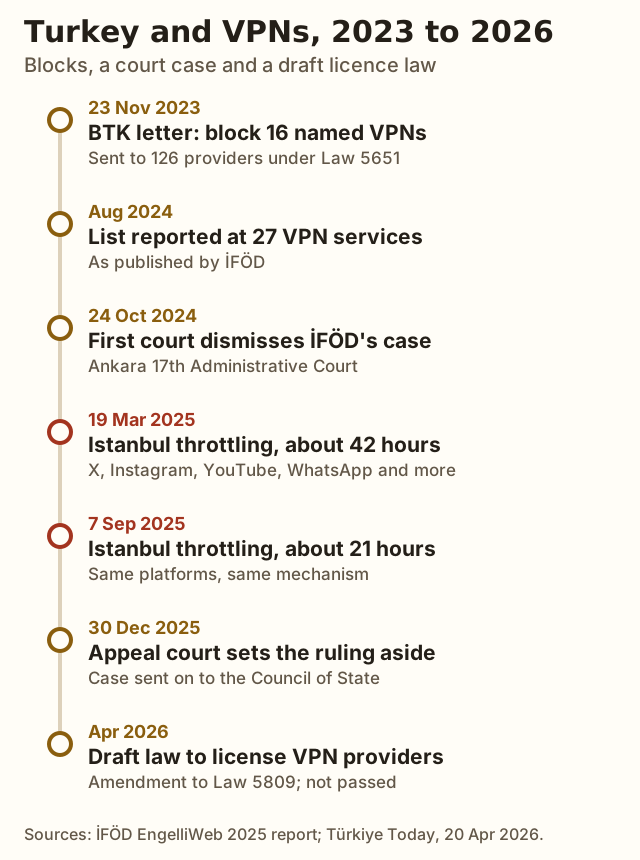
Using a VPN is not a crime for individuals in Turkey. What the state does is block VPN services. A letter from the regulator, the BTK, dated 23 November 2023 told access providers to block 16 named VPNs; a list reported in August 2024 had grown to 27; and a draft amendment that surfaced in April 2026 would require VPN providers to be licensed. So the legal answer is “allowed”, and the practical answer is that many well-known services are blocked.
Below: what the law says, what has been blocked, and what is changing. For the wider legality map, see our VPN legality-by-country guide. Not legal advice — verify the current rules with an official source before you travel.

Photo: “Istanbul skyline 03” by SegLig, CC BY 4.0, via Wikimedia Commons.
Is a VPN legal in Turkey?
Yes, for ordinary use. No Turkish law makes it an offence for an individual to use a VPN, and enforcement targets the services rather than their users. The Freedom of Expression Association (İFÖD), a Turkish digital-rights group, goes further: it argues that no law prohibits reaching blocked sites by other means or using a VPN from Turkey, and that the regulator had no power to pick VPN services to block.
How Turkey blocks VPNs
The BTK, Turkey's Information and Communication Technologies Authority, leads the blocking. Its letter of 23 November 2023, sent to 126 content, hosting and access providers, named 16 services: Proton VPN, Surfshark, IPVanish, CyberGhost, PureVPN, TunnelBear, Hotspot Shield, NordVPN and ExpressVPN, plus Psiphon, Hola VPN, Turbo VPN, HideMyAss, Touch VPN, Private Internet Access and Secure VPN. The legal basis cited was Article 6(1)(ç) of Law No. 5651, which obliges access providers to take measures against “alternative access” to blocked content. İFÖD's measurements found blocked server addresses belonging to 26 VPN services in 2023, and selective interference with Proton VPN traffic on some networks, triggered by the site name in the connection and dropped silently. Turkey also blocks large numbers of websites and domains generally.
The court case over the VPN blocks
İFÖD challenged the BTK's letter in court on 28 February 2024. The Ankara 17th Administrative Court dismissed the case on 24 October 2024. On 30 December 2025 the Ankara Regional Administrative Court set that decision aside, ruling that the letter was a regulatory act and so a matter for the Council of State, Turkey's top administrative court. İFÖD's report published in July 2026 lists the case as pending there.
The 2026 draft licence law
In April 2026 a draft amendment to Electronic Communications Law No. 5809 surfaced that would bring VPN providers under a licensing regime. Türkiye Today reported on 20 April 2026 that the BTK had begun work on the rules after school attacks, alongside a separate plan for supervised mobile lines for under-18s, and that the measures were still under development. We found no report that it had been passed when we last checked on 28 October 2026. If it is passed, the question for users will be which providers are licensed, and what licensing requires of them.
The legal picture for visitors and residents
For visitors and residents alike, using a VPN for ordinary, legitimate purposes is not itself an offence today; the obstacle is that many services are blocked. Turkish law on content and speech still applies whatever the connection, so a VPN doesn't make it lawful to publish or access something that's an offence locally. The draft licence law is the change to watch before any trip.
Turkey compared with its neighbours
Turkey sits in the heavily restricted tier alongside China and Russia, but its posture is distinct: it blocks services without criminalising personal use, so the story is availability, not arrests. If your itinerary also includes the Gulf, contrast this with the UAE, where the tool is legal but misuse is heavily fined, and with Russia's escalating crackdown.
Why Turkey blocks so much
Turkey's approach is shaped by a long-running policy of tight control over online content and platforms. Under the country's internet law, authorities can order sites blocked quickly, and reports have counted hundreds of thousands of blocked domains over the years. Social platforms have faced throttling and takedown demands around sensitive events. VPNs become a natural target in that environment, because they're the tool most people reach for to get around blocks — so the state blocks the VPNs too. The result is a censorship posture that's broad and fast-moving, but focused on access control rather than criminal prosecution of ordinary users.
If your VPN won't connect in Turkey
If a VPN app that works at home fails to connect in Turkey, the likeliest reason is that its service is one of those the BTK has ordered blocked, not a fault with your device. Provider websites and app-store listings can be blocked too, so installing or updating an app inside the country may not work. We don't give instructions for getting around those blocks. Your options are lawful ones: check with your provider, and use services that are available locally.
Which services are commonly disrupted in Turkey?
Beyond VPN brands, Turkey restricts access to particular platforms and large numbers of individual websites, especially around elections, security incidents or contentious news. İFÖD's report records two episodes in 2025: from 19 March, after the detention of Istanbul's mayor Ekrem İmamoğlu, X, Instagram, Facebook, TikTok, YouTube, Twitch, WhatsApp, Telegram and Signal were throttled across Istanbul for about 42 hours; from late on 7 September, when police cordoned off the CHP's Istanbul headquarters, much the same list was throttled for about 21 hours. Because the targets change with events, there is no fixed list of what is blocked this week.
Is a VPN worth it for a short trip to Turkey?
For security on hotel and café Wi-Fi, a VPN does the same job in Turkey as anywhere else, and using one for that is lawful. The catch is availability: if your provider is among the blocked services it may not connect at all, so check before you travel. Keep your use ordinary and lawful, and remember that Turkish content laws apply regardless of the VPN.
Frequently asked questions
Is it legal to use a VPN in Turkey?
Which VPNs are blocked in Turkey?
Is there a licensed or approved VPN in Turkey?
Can tourists use a VPN in Turkey without trouble?
Planning a trip or a move? Start with the VPN legality-by-country guide, or read up on using a VPN behind the Great Firewall.