Internet Censorship Explained: How Blocking Works and Who Does It
Internet censorship is any deliberate control over what people can reach or publish online. Usually a government orders it and network operators carry it out. It ranges from blocking one website to throttling an app until it's useless, or switching the internet off across a region. In 2025 Access Now recorded 313 shutdowns in 52 countries, a record, and Freedom House's 2026 report, published on 22 October 2026, found global internet freedom falling for the 16th year in a row.
This explainer covers how blocking works at each step of a web request, who does it, the latest measured data, and where a VPN helps and where it doesn't. It's general information about how the internet is controlled, not legal advice about any country. For whether a VPN is lawful where you are, start with our VPN legality guide.
What is internet censorship?
Internet censorship means a decision that some information shouldn't reach some people, enforced by technical means. The reasons vary: political control, religious or moral rules, national security, copyright and gambling laws, or child protection. The tools are the same everywhere. A DNS block that stops a gambling site in one country can stop a news site in another, and it is the reason given, not the method, that differs.
It helps to separate three things people call censorship. Network blocking is done by internet providers on a government's order. Platform moderation is when a social network or app store removes content under its own rules or a legal demand. Shutdowns cut connectivity altogether. This guide is mostly about the first and third, because those are what a traveller or resident runs into, and what a VPN can or can't change.
How blocking works: DNS, IP, SNI, DPI, throttling, shutdowns
Every time you open a website, your device makes a series of small requests, and each one is a point where a network can step in. Measurement projects such as OONI (the Open Observatory of Network Interference), which publishes open data on blocking around the world, define the main techniques.
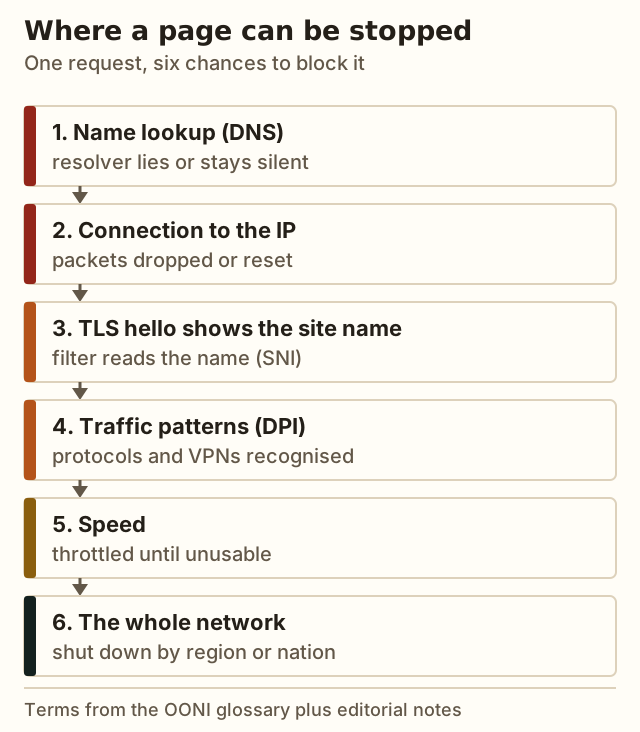
- DNS tampering. Before connecting, your device asks a DNS resolver for the site's address. OONI calls DNS tampering an umbrella term for interference at this step, including a 'dishonest' resolver that 'intentionally' returns a wrong answer. The site then seems not to exist, or you land on a block page.
- TCP/IP blocking. The network refuses to let you connect to the server's IP address. Per OONI, this means 'preventing a client from establishing a TCP connection', by dropping the packets or by sending a fake reset. It is blunt and can catch other sites hosted on the same address.
- SNI filtering. When your browser opens an encrypted connection, the first message names the site you want (the Server Name Indication, or SNI), and on most connections that name isn't yet hidden. A filter can read it and cut the connection without decrypting anything.
- Deep packet inspection (DPI). Specialised equipment looks at the shape and timing of traffic to identify protocols and apps, including VPNs. That lets a network block a whole category, such as all WireGuard tunnels, rather than a list of sites.
- Throttling. Instead of blocking, the network slows a service until it's useless. It's harder to prove than a block, which is part of its appeal to censors.
- Shutdowns. The bluntest tool: cutting mobile data or all connectivity for a city, region or country, often around protests, elections or exams.
| Method | What it stops | Scale | Does a VPN help? |
|---|---|---|---|
| DNS tampering | Finding a site's address | Per site | Yes: lookups go through the tunnel |
| TCP/IP blocking | Connecting to a server | Per address; can hit neighbours | Yes, unless the VPN server's IP is blocked |
| SNI filtering | Encrypted visits to a named site | Per site | Yes: the site name is inside the tunnel |
| Deep packet inspection | Whole protocols, VPNs included | Per protocol | Only with an obfuscation mode, and not always |
| Throttling | Usable speed | Per service or link | Sometimes, if one service is targeted |
| Shutdown | All connectivity | Region or country | No |
Encryption has changed which techniques censors rely on. Google's Transparency Report shows that in the week of 4 October 2026, between 87.9% (Linux) and 99.5% (ChromeOS) of Chrome page loads used HTTPS. With HTTPS, a network can't see which page on a site you read, only which site. That's why modern blocking concentrates on site names (DNS and SNI), addresses and traffic patterns, and why a list of banned URLs matters less than it used to. OONI also defines HTTP blocking, interfering with unencrypted web requests, which now covers only a small share of browsing.
Who censors: governments, ISPs, employers, platforms
Most national blocking is ordered by a government and carried out by internet service providers, which must comply with their licence or the law. In some countries a central gateway handles all international traffic. China's rules, for example, require international connections to go through the state's approved gateway channels. In others, each ISP runs its own filters, so what's blocked can differ between mobile networks.
Censorship also happens below the national level. Employers, schools and hotels filter their own networks, usually with the same DNS and DPI techniques at smaller scale. That's legal almost everywhere and is a matter of their acceptable-use rules. Platforms are a third layer: app stores remove apps, including VPN apps, at a government's request, and social networks restrict posts or accounts in particular countries.
Knowing which layer is blocking you tells you what is likely to work. A site blocked on hotel Wi-Fi may open fine on mobile data. A government-ordered block usually applies to every provider in that country. And an app removed from one country's app store stays on devices that already have it, though it may stop updating.
The 2025-2026 numbers (shutdowns, country scores)
Two long-running data sets give the clearest picture. Access Now's #KeepItOn coalition counts government-ordered internet shutdowns each year. Freedom House's Freedom on the Net project scores countries on internet freedom: its 2025 edition covered 72 countries, and its 2026 edition assessed 38.
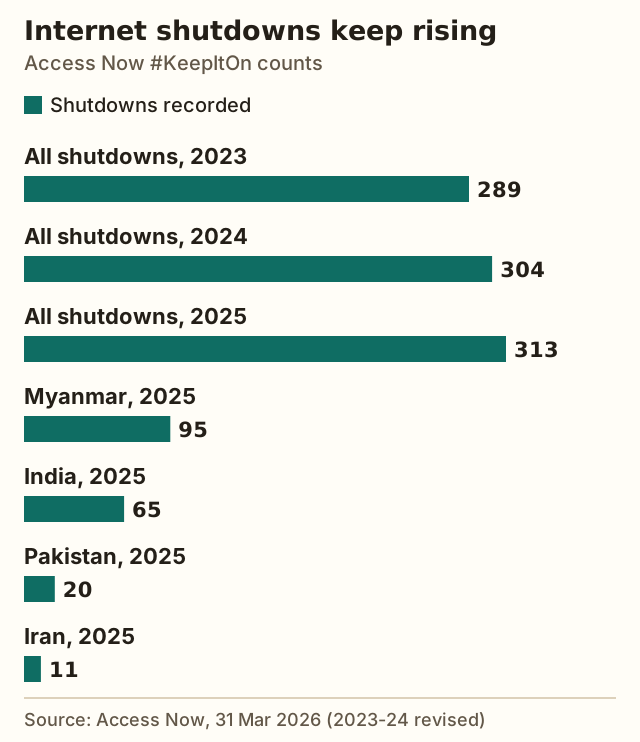
Access Now's 2025 report, published on 31 March 2026, recorded at least 313 shutdowns in 52 countries, the highest number it has logged. It revised its 2024 count to 304, up from the 296 it first published. Myanmar led for the second year running with at least 95, 76 of them imposed by the military. India followed with 65, then Pakistan with 20 and Iran with 11. Conflict was the biggest driver: Access Now linked 125 shutdowns in 14 countries to conflict, about 40% of the total. It also recorded 14 shutdowns of satellite internet in seven countries, up from four in 2024.
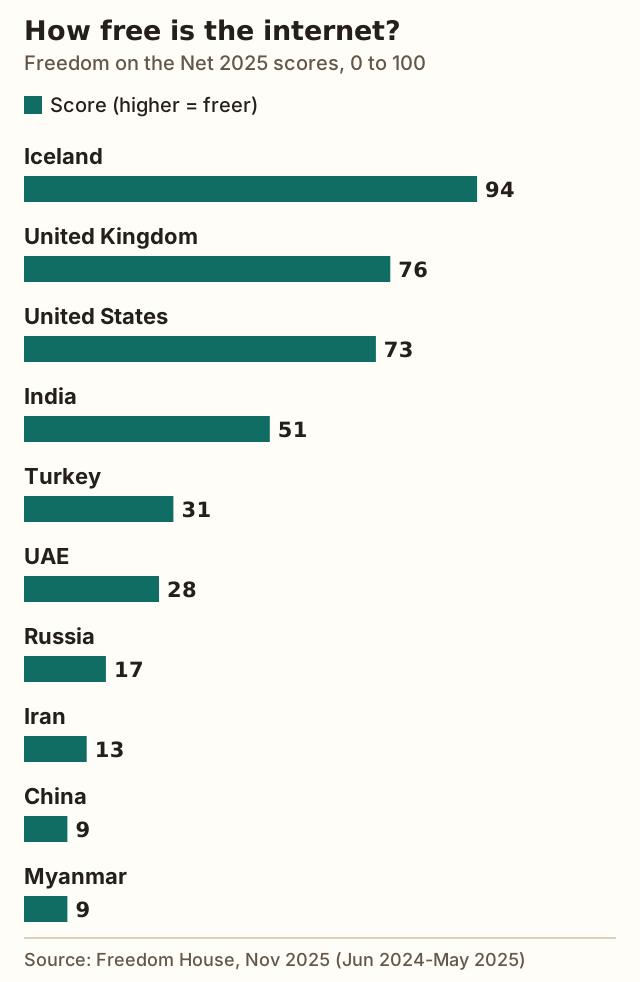
Freedom on the Net 2025, published on 13 November 2025 and covering June 2024 to May 2025, found internet freedom declining for the 15th consecutive year. China and Myanmar tied at the bottom with 9 out of 100, and Iceland stayed at the top with 94. Democracies slipped too. The United States fell from 76 to 73 and the United Kingdom from 78 to 76. Russia dropped from 20 to 17, and its country report cites the expanded blocking of VPNs. Kenya had the largest single-year fall, which Freedom House links to a shutdown during protests in June 2024.
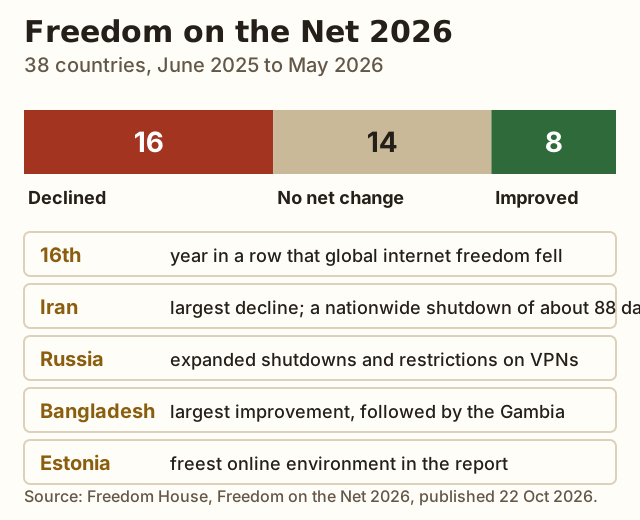
Freedom on the Net 2026 followed on 22 October 2026, covering June 2025 to May 2026. Conditions worsened in 16 of the 38 countries it assessed and improved in 8. Iran had the largest decline, including a nationwide shutdown of about 88 days, the longest the project has recorded, and joined China and Myanmar as the worst environments. Russia expanded shutdowns and restrictions on VPNs. Bangladesh improved most, followed by the Gambia, Estonia was the freest, and Georgia fell from Free to Partly Free. The country scores in the chart above are from the 2025 edition.
The two data sets measure different things. A country can have few shutdowns yet a low score because it filters content constantly, as China does. Another can score reasonably well but still cut access during unrest. Read both together, and check the dated country pages before you rely on either. We compare countries' VPN rules side by side in our VPN rules by country guide.
A short tour of the most restrictive places
The same handful of countries appear at the bottom of both data sets, but each controls the internet in its own way. These summaries use Freedom House's 2025 scores and Access Now's 2025 counts; our country pages hold the dated legal detail.
China (score 9). Control is built into the network's structure. China's international-networking rules require cross-border connections to use the state's approved gateway channels. A 2017 Ministry of Industry and Information Technology notice barred unapproved dedicated lines, VPNs included, for cross-border business. Blocking is constant rather than episodic, which is why China records few shutdowns but the lowest score. See is a VPN legal in China.
Myanmar (score 9; 95 shutdowns). Here the dominant tool is the shutdown: Access Now attributes 76 of 2025's 95 to the military. Blocking and VPN restrictions sit on top of repeated regional cut-offs.
Iran (score 13; 11 shutdowns). Heavy filtering combines with shutdowns during unrest. Iran's 2025 score was one point higher than the year before.
Russia (score 17). Russia fell three points in a year, and Freedom House's report highlights expanded VPN blocking. The method has shifted from blocking individual services towards blocking protocols. Our Russia guide tracks what that means for visitors.
India (score 51; 65 shutdowns). India's score is mid-table, but it ordered the second-highest number of shutdowns in 2025, often regional and tied to security operations or exams. See our India VPN guide.
Turkey (31) and the UAE (28). Both block content and services under national law. In the UAE, the law targets misuse rather than VPNs themselves, as our UAE and Dubai guide explains. Turkey's restrictions are covered in our Turkey guide.
How censorship is measured
Every number in this article comes from organisations that publish their methods, and it is worth knowing their limits. OONI's free OONI Probe app lets volunteers test whether websites, messaging apps and circumvention tools are reachable on their network. OONI then publishes every measurement openly. That gives hard evidence of how a block works, but only where volunteers run tests.
Access Now's #KeepItOn coalition documents shutdowns country by country and revises earlier years as evidence arrives. Its 2024 total rose from 296 to 304 after first publication. Freedom House scores countries on three areas: obstacles to access, limits on content and violations of user rights. Its yearly reports cover a June-to-May period, so they lag events by several months. Neither covers every country, so treat both as strong evidence rather than a complete census.
Where a VPN helps and where it doesn't
A VPN helps against the blocking methods that look at where you're going. It carries your traffic inside an encrypted tunnel to a server in another country. Your local network sees only a connection to that server, not your DNS lookups, the site names you visit or the addresses you connect to. That defeats DNS tampering, IP blocking and SNI filtering on the local network, which is why VPNs are the standard tool for reaching blocked sites.
A VPN does not help against everything:
- DPI aimed at VPNs. Where the network recognises VPN traffic itself, an ordinary VPN connection gets blocked. Providers answer with obfuscation modes that disguise the tunnel. Results vary and change from month to month.
- Shutdowns. If there's no internet, there's nothing to tunnel through.
- Throttling of all foreign traffic. A VPN can't speed up a deliberately slowed international link.
- Platform removals. A VPN can't restore a post a platform has removed worldwide.
- The law. A VPN changes what the network sees, not what the law says. Several countries that censor heavily also restrict VPN use. Our list of countries that restrict VPNs covers who and how.
Some providers sell obfuscation modes aimed at restricted networks, and some say plainly that their apps don't work in particular countries: NordVPN's own help pages say its apps are blocked in China. Whether you may use a VPN at all is a question of local law, and that is what we track. Our country-by-country rules and the China guide set out the legal position; we don't give instructions for getting around a government's blocks.
Censorship vs surveillance
Censorship decides what you can reach. Surveillance records what you do. They often come together, but a VPN deals with them differently. Against local surveillance, such as your ISP, a café network or a government monitoring domestic links, a VPN hides your browsing from that observer. It does not make you anonymous. Your traffic is then visible to the VPN provider instead, which is why audited no-logs policies matter. And it gives no protection once you sign in to an account that identifies you.
Against a state that can compel local companies, the important question is where the VPN provider is based and what it keeps. A provider outside that country's jurisdiction, with independently audited no-logs claims, limits what can be demanded. Use within the country is a separate legal question.
What changed in 2025-2026
The past two years pulled in two directions. In authoritarian states, blocking moved from individual sites towards whole protocols and VPN services. Freedom House's Russia report describes expanded VPN blocking, and shutdowns reached a new high. In democracies, the debate moved to age verification. The UK's children's safety rules took full effect on 25 July 2025, and the UK government says daily VPN users rose from about 650,000 before that date to over 1.4 million by mid-August 2025. Several US states passed age-verification laws, and Utah's 2026 law is described in press reports as the first to target VPN use.
Turkey shows the second half of that trend. The Freedom of Expression Association (İFÖD) recorded social media being throttled across Istanbul for about 42 hours from 19 March 2025, and for about 21 hours from 7 September 2025, and in April 2026 a draft amendment surfaced that would require VPN providers to be licensed. Our Turkey guide follows both.
Those democratic rules are not censorship in the same sense: they place duties on websites rather than blocking political speech. But they show how quickly VPN use becomes part of the argument. Check the dated, sourced status for a country before you travel. Rules and enforcement in this area change from one quarter to the next.
Blocked, or just down? How to tell
Before assuming censorship, check the simpler explanations. A site that fails everywhere is probably down; a site that fails only on one network is probably blocked there. Some useful signals:
- A block page naming a regulator or court order is the clearest sign of a deliberate block.
- An error saying the site 'can't be found' on one network, but loading on mobile data, points to DNS tampering.
- A connection reset just after you start loading, on a site that otherwise exists, often means SNI or IP filtering.
- Everything loading slowly except domestic sites can mean throttling of international links, or simply congestion.
OONI publishes its measurements on its public explorer, so you can often check whether others have recorded the same block. It's the most reliable way to tell a fault from a filter without guessing.
Edge cases
- Censorship on your home network: parental controls and ISP 'safe' filters use the same DNS blocking. Changing your DNS resolver often lifts them, and that's legal for your own connection.
- Blocked VPN websites, working apps: some countries block VPN providers' websites and app-store listings before they block the servers themselves. Install and log in before you travel.
- Partial shutdowns: some shutdowns cut mobile data but leave fixed broadband, or block only certain apps. A connection that works for some services isn't proof that nothing is restricted.
- Being blocked by the other side: some sites block visitors from certain countries or from VPN addresses. That's the site's choice, not censorship by your network.
Internet censorship: common questions
What is internet censorship, explained simply?
How do governments block websites?
Which countries censor the internet the most?
Can a VPN get around internet censorship?
How many internet shutdowns were there in 2025?
Planning a trip or a move? Start with the VPN legality-by-country guide, or read up on using a VPN behind the Great Firewall.